Bringing General-Purpose Robots to Every Construction Site: Inside Big-D Construction's Expansion with FieldAI
Bringing General-Purpose Robots to Every Construction Site: Inside Big-D Construction's Expansion with FieldAI
"I think the opportunity is that every project will have some representation of FieldAI tools." That's Shaun Orr, C-level executive and 25-year veteran at Big-D Construction. He's not speculating about the future, he's describing the next step for a partnership that is expanding across the company's portfolio.
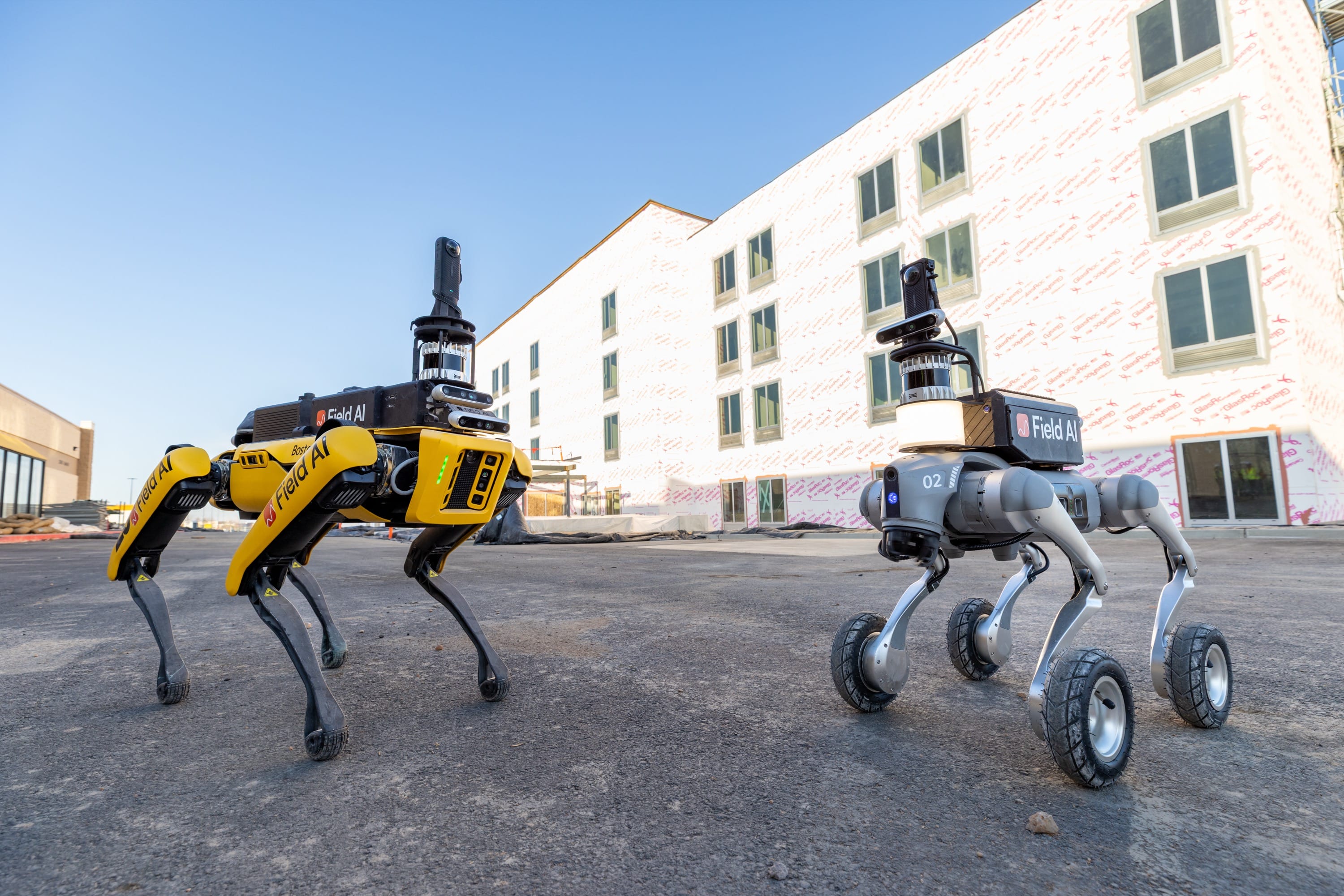
Active construction sites are among the most demanding environments in robotics, constantly changing, unpredictable, and historically out of reach for reliable autonomy. This is exactly where FieldAI is already operating today. Its Field Foundation Models are the intelligence behind robots deployed across construction and industrial sites globally, enabling them to navigate, manipulate objects, and deliver value in real-world conditions where other approaches break down.
Unlike conventional systems that depend on maps, GPS, or predefined routes, FieldAI-enabled robots are deployed directly into active job sites with minimal setup. They adapt in real time to changing conditions, allowing teams to integrate them into live workflows without the overhead typically associated with robotics deployments. This shift not only expands where robots can operate, but also significantly reduces the cost and effort required to deploy them at scale.
A labor crisis with no end in sight
"We've got a big labor crisis in the construction industry," Orr said. "Everybody feels it. We've been in that space for years, and we don't really anticipate that stopping until 2040 or beyond."
On the ground, the pressure falls on superintendents who are already running at capacity. Bronson Dupaix, a Big-D Superintendent described what data collection looked like before the FieldAI robots arrived. He and his team were spending five hours during each job walk with various sensors, handheld cameras, scanners, or lidars on a daily and weekly basis for various missions. That was time that could have been spent solving higher-level problems.
The moment it clicked
For Orr, the defining moment came when he saw the technology do something no person on a job site could do alone.
"They had one of their robots on the ground that had the schedule and the model attached to it, was real-time walking a project site and identifying problems — missing work, safety issues — and correlating it back to all of the great detail that our people have put into our other platforms," Orr said. "Seeing it in a way that we just couldn't see it."
What stood out was not just a single capability, but the ability to bring multiple functions together into one system. Instead of deploying separate tools for inspection, documentation, manipulation, material transport, and security, a single robot could handle multiple workflows in one pass. That compounding effect significantly increases the return on each deployment, turning the robot into a continuously operating creator of value rather than a single-purpose tool.
%20copy.jpg)
The decision to go all in
For over two years of field deployments, FieldAI has worked closely with the Big-D team to incorporate their feedback into the product. These deployments are part of a broader track record of real-world operations across numerous sites globally, where systems are already running in live customer workflows.
"One of the things that I'm most grateful for is that FieldAI really approached this as a partnership and allowed us to participate in the development of that application in our own organization," Orr said.
"The project team feedback was just overwhelmingly positive. It made the decision to make a bigger investment pretty easy to do."
Chantelle Menlove, a director at Big-D's with deep expertise in virtual design and construction (VDC), identified the right projects for the expansion and something happened that surprised her.
"That same superintendent that had the robot on his job for the first time called me last week as I was on the other job site deploying two more robots," she said. "He said, 'When can I have it on my job? What do I need to do?' And he's really excited about taking it to his next job."
Demand is emerging from every level of the organization, from superintendents in the field to executive leadership. What starts as clear value on individual job sites is quickly recognized as a system-level advantage, shaping how these technologies will scale and transform operations across the business in the years ahead.
The vision ahead
Orr sees FieldAI becoming a standard part of how Big-D operates, as it is already moving from individual deployments toward company-wide adoption.
"Every project will have some representation of FieldAI tools," he said. "They integrate with our existing platforms today in a way that we are pulling value. And I look at our teams really embracing the technology in a way that was surprising to me. It wasn't scary. It was more like having a new, great companion join the team."
As deployments expand, what emerges is not just a new tool, but a new operational layer for construction. FieldAI is building a general-purpose autonomy layer that operates across different robot types and enables coordinated systems of robots to work together. This approach is setting a new standard for how robotics is deployed in real-world environments, moving beyond isolated automation toward integrated, scalable systems.
Menlove is already thinking about what comes next.
"The future that I see with robots is that we're really going to have tools that we've never had before," Menlove said. "Robots doing functions on the job that we only wish we had help with — carrying materials, delivering materials, being a second set of hands on the job. I'm really excited to see what each one of these robots and the different types that we're going to have on our job sites, and how they can all talk together and move together to really make our projects successful."
When asked what he tells colleagues in the industry who haven't heard of FieldAI, Orr doesn't hold back.
"Maybe what my cohorts hear when I talk to them about it is: you better get it, because we're going to pass you up."

Robot intelligence built for the real-world.
