FieldAI and NVIDIA Omniverse: Building the Next Generation of Industrial AI
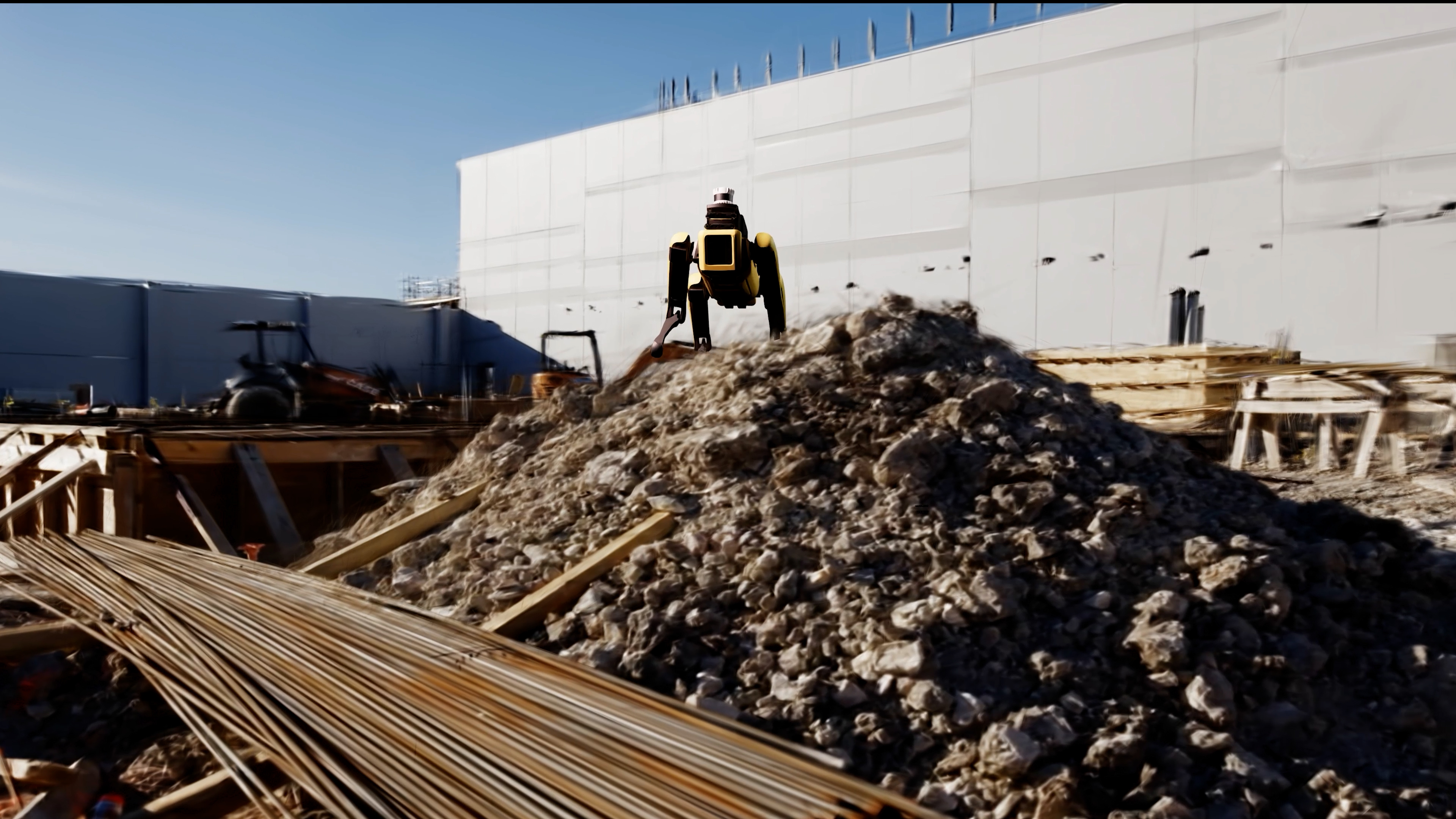
FieldAI-enabled robots operate in some of the most challenging environments in industry, from active construction sites where conditions change hourly to mining and energy operations with extreme conditions, limited access, and complex infrastructure. These are the kinds of settings where autonomy has the highest value, and also where it's hardest to deploy.
The unique architecture of Field Foundation Models (FFMs) combines data-driven AI with physics-based reasoning and uncertainty awareness to enable safe deployment in unstructured environments. Once deployed, FieldAI’s robots can generate continuously evolving digital twins of customer sites, turning what used to take months of manual effort into something that happens in hours as a byproduct of normal operations. These living digital twins form the foundation for a range of high value capabilities from visibility and planning to analysis and optimization. That same backbone enables rigorous, large scale verification and validation in environments that are traditionally impossible to simulate. Together, this transforms field operations into a scalable data and digital infrastructure layer for industrial AI.
NVIDIA Omniverse libraries provide the digital substrate that accelerates the transition from field data to intelligent digital worlds. Omniverse unifies simulation, AI, and real world data into a single interoperable platform. Within that ecosystem, Omniverse’s reconstruction capabilities, powered by NVIDIA Omniverse NuRec, transform raw operational sensor data into high-fidelity, interactive 3D environments. Because these environments integrate directly with existing tools like NVIDIA Isaac Sim / NVIDIA Isaac Lab open simulation and learning frameworks and NVIDIA OSMO, which FieldAI already uses for model training and autonomy validation, NuRec enables a scalable pipeline to transform robot data from real deployments into simulation-ready digital infrastructure.
Where NuRec Fits in Our Stack
FieldAI has a deep, ongoing collaboration with NVIDIA across the Omniverse ecosystem. We use Isaac Lab for training various policies through large-scale parallel reinforcement learning, in conjunction with real world data-based training. We use Isaac Sim for testing and software-in-the-loop validation.
NuRec serves as the front end of the real-to-sim pipeline, streamlining this process by transforming our unique operational data from live deployments into simulation ready environments. Each robot becomes a persistent sensor node, expanding a library of reconstructed environments. The result is a compounding real-world data advantage that strengthens both validation infrastructure and customer facing digital twin products over time.
With deployments scaling across three continents, the volume of real-world data flowing into this pipeline has accelerated. OSMO gives us the ability to automate key stages of this workflow, from data ingestion through reconstruction and quality validation, so that new environments can flow into simulation continuously. Every deployment makes the simulation pipeline richer without adding operational overhead, and customers gain access to an increasingly valuable Omniverse ecosystem.
From Real Sites to Simulation
The workflow starts with data capture. As FieldAI robots carry out their missions, they collect highly precise multimodal information including vision, depth, LiDAR, and many other sensory modalities that together form a rich representation of the environment. The important thing is that this data is captured as a natural byproduct of the robot doing its job. There's no separate scanning step required.
In combination with NuRec, that operational data is transformed into high-fidelity digital replicas of customer sites. The reconstructions capture the visual complexity of the actual site, including everything from fine details of individual fixtures and equipment to large-scale outdoor terrains.
From there, the reconstructed environment can be loaded into Isaac Sim, enabling validation, scenario analysis, and performance testing in the conditions captured on the site. The result is a direct bridge between live field operations and persistent, simulation-ready digital worlds.
What makes this different from the typical NuRec use case is the type of environment. FieldAI is bringing NuRec into unstructured outdoor and industrial environments that are difficult to capture and reconstruct: construction sites with heavy equipment, scaffolding, and debris; energy facilities with complex piping and infrastructure; underground mining environments with poor visibility and harsh conditions. These are precisely the environments where autonomy delivers the greatest economic value and where simulation has historically been the most difficult to achieve.
What This Unlocks
Bringing real unstructured environments into simulation closes the gap between verification smoke tests and operational customer value.
For customer value, the impact is immediate. Many of our customers already use robots equipped with 360-degree cameras for reality capture, collecting images at set points throughout a site. Our technology, in combination with NuRec, opens the door to upgrading from stitched images at fixed viewpoints to full 3D reconstructions with continuous coverage and the ability to view the site from any angle.
The combination of FieldAI’s technology and NVIDIA Omniverse NuRec makes digital twins practical in a way they haven't been before. Traditional digital twins are time consuming to generate, which means they're often out of date before they're finished, especially on sites where conditions change frequently. Now , high-quality reconstruction can happen continuously as the site evolves, rather than as a one-time effort.
When brought into Omniverse, these environments become more than visual replicas. Assets can be isolated, analyzed, and manipulated at the object level, enabling layout planning, spatial analysis, and operational optimization that are not possible with conventional reconstructions.
For verification and validation, reconstructing real sites helps close the gap between tests of a robot’s capabilities in simulation and what it faces on the job. Our robots already operate in a risk-aware fashion in these environments thanks to the architecture of FFMs. When the model encounters something unfamiliar, it adapts in real time by slowing down or choosing a more conservative path. That conservatism has a cost in throughput and efficiency. Training in reconstructed real-world environments helps quantify how often it kicks in by exposing the model to scenarios it may encounter in the field, from changing lighting conditions and reflective surfaces to thin obstacles and unexpected clutter. The result is a robot that operates more efficiently across a wider range of real-world conditions.
It also opens the door to richer training over time. When a reconstructed environment is brought into Omniverse, it becomes possible to build object-level semantic understanding on top of the visual reconstruction. A standard 3D reconstruction is a fixed visual snapshot where everything in the scene is baked together. Once you add semantic layers in Omniverse, individual objects (a piece of equipment, a tool, a valve, a panel) can be identified and reasoned about independently. This is especially valuable for manipulation training, where a robot needs to understand not just where things are in the scene but what they are and how to interact with them.
What's Next
The real to sim pipeline is only the beginning. In collaboration with NVIDIA, FieldAI is expanding beyond reconstruction toward generative industrial environments, where real world deployments seed entire families of high fidelity simulated worlds.
FieldAI and NVIDIA are continuing to push this work forward, and we're excited to share more at NVIDIA GTC 2026 in San Jose (March 16-19). If you're attending, visit us at South Market Lot booth #7026.

Robot intelligence built for the real-world.
