How FieldAI and Boston Dynamics Made Robot Autonomy Practical on Construction Sites
How FieldAI and Boston Dynamics Made Robot Autonomy Practical on Construction Sites
Construction Is Changing Fast—and Autonomous Intelligence Is Why.
Leading builders are doing more with less by deploying general-purpose robots that are already delivering measurable returns at scale.
Construction sites have long been among the most difficult environments for robotics. They evolve constantly: workers and machines in motion, materials arriving without notice, and partially completed structures reshaping the environment day by day. The construction industry has long been ready for autonomy—and the need is only growing—but success has depended on building intelligence that can adapt to environments that change every day.
FieldAI is changing that.
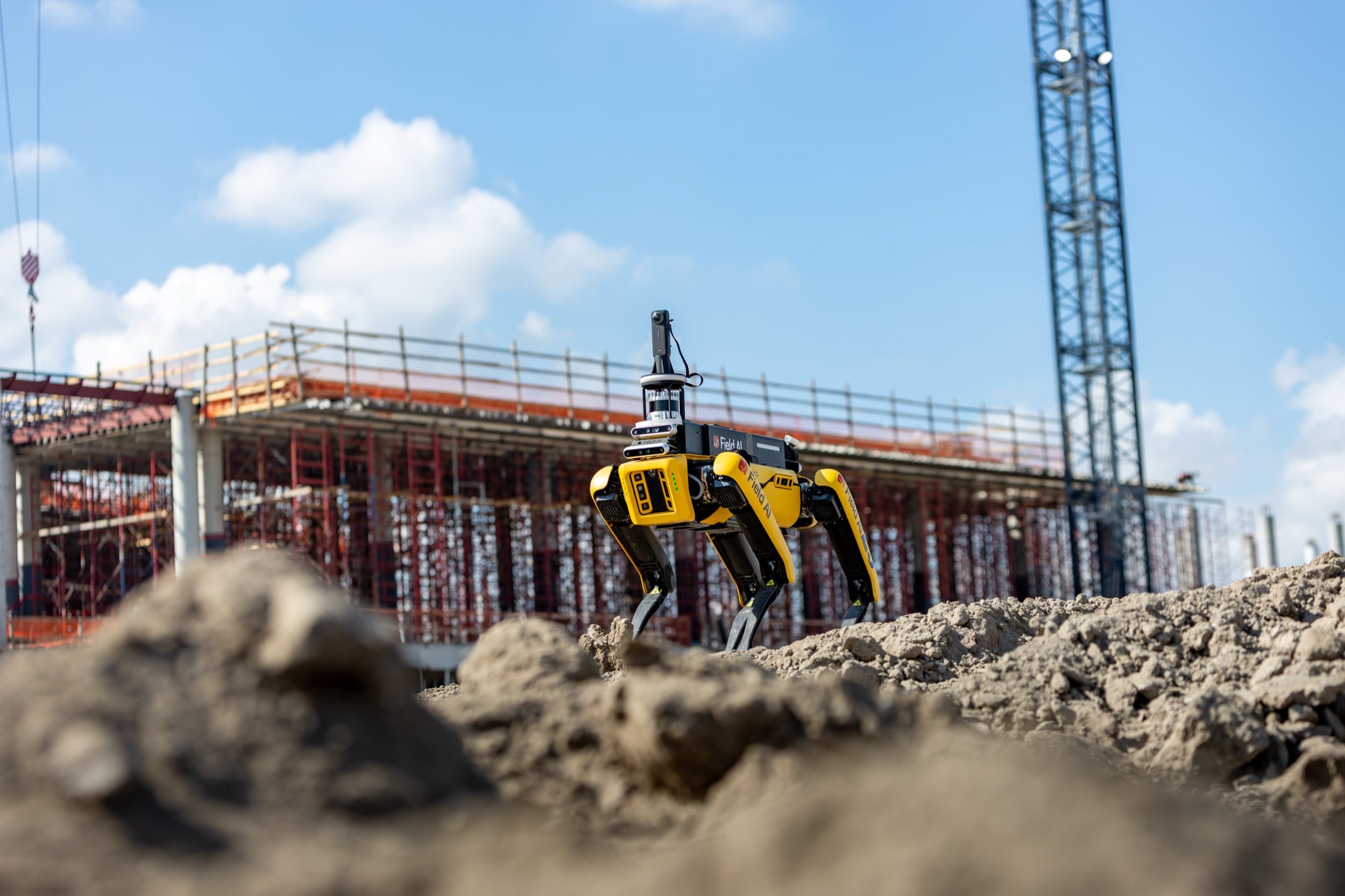
Founded to overcome these challenges, FieldAI set out to make robots reliable, scalable tools for the global construction industry. Headquartered in Irvine, California, the company developed Field Foundation Models (FFMs) that enable robots to understand risk and make decisions in real time at the edge. By pairing its software with Boston Dynamics’ agile quadruped robot, Spot, FieldAI created a mobile platform capable of operating in construction environments once considered too complex and chaotic for automation.
“Construction sites are unpredictable by nature,” said Ali Agha, Founder and CEO of FieldAI. “The real breakthrough is building robot brains that understand risk and make decisions in real time. That kind of intelligence allows robots to adapt on their own, delivering a new level of reliability, insight, and immediate ROI in complex environments.”
Designing robots for constant change
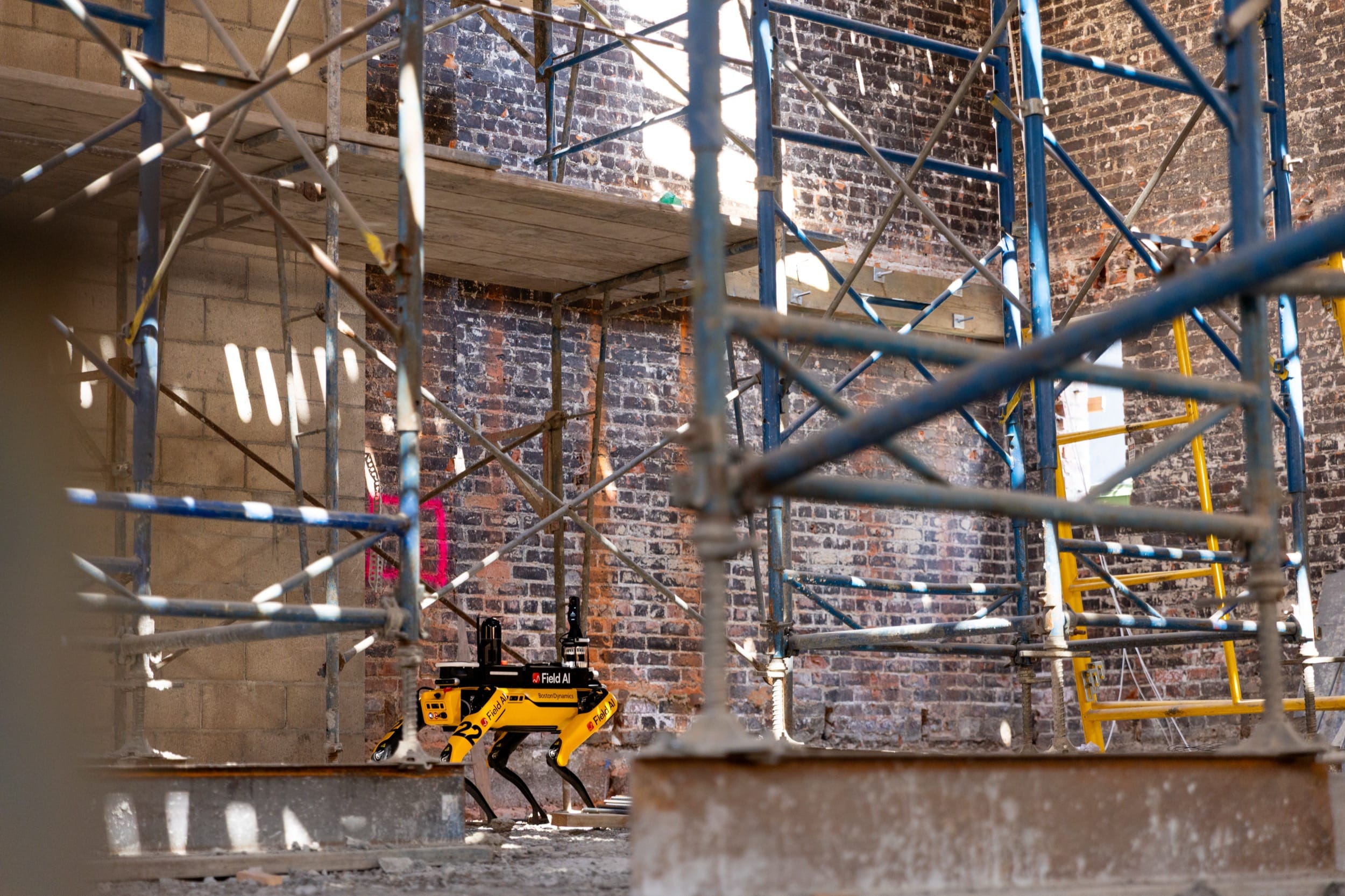
Historically, robotic systems in construction have relied on BIM or CAD data, struggling when static maps fail to keep pace with job sites in constant flux. FieldAI’s FFMs change that dynamic. Powered by cameras, LiDAR, and onboard sensors, FieldAI’s FFMs enable Spot to execute complex inspection, mapping, and monitoring tasks with no prior maps and no pre-defined routes. With contextual awareness, Spot can navigate bustling construction sites where wheeled or tracked systems typically fall short.
FieldAI-powered Spot can complete missions without frequent resets or manual correction, even when conditions differ from hour to hour. The system can operate continuously, including overnight, delivering updated site data to project teams each morning. By eliminating the need for GPS, cloud connectivity, prior maps, or pre-planned trajectories, the FieldAI brain enables rapid, infrastructure-free deployment and reliable operation in constantly changing job sites.
Data integrates with customer’s existing workflow
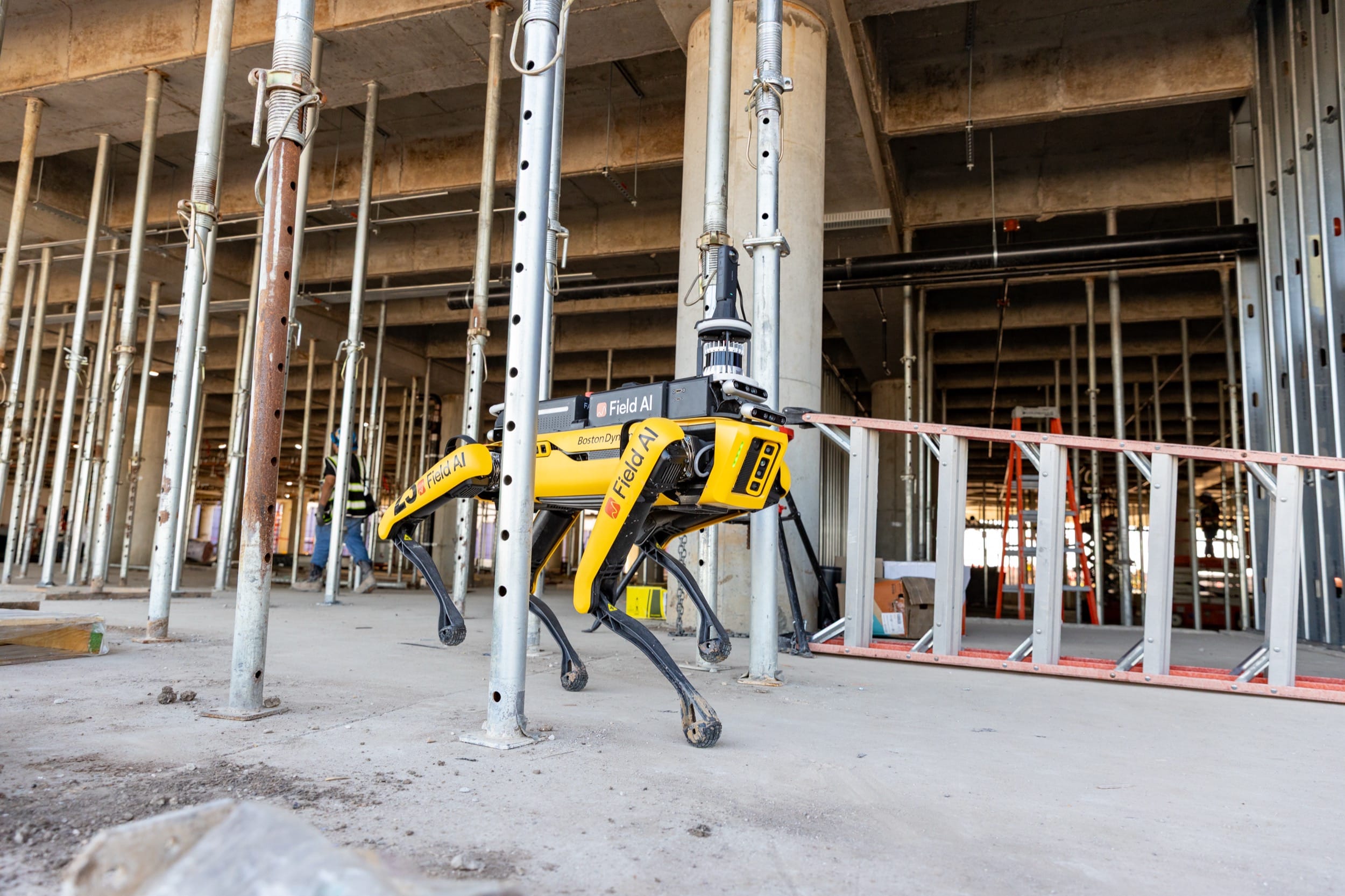
Designed as a general-purpose platform, the robot supports multiple inspection and monitoring tasks in a single job walk and integrates directly into existing workflows, enabling immediate ROI. Data collected by Spot flows seamlessly into BIM and digital twin systems, delivering actionable insights across progress tracking, quality verification, and deviation analysis.
The platform also extends visibility into areas that are impractical or hazardous for crews to access, surfacing a broad range of site conditions—including safety-related observations such as holes, drop-offs, PPE compliance, active machinery, slippery surfaces, and other evolving hazards.
“Before Spot and FieldAI, robots on our sites struggled when conditions changed. Now we deploy them daily,” said a senior project manager overseeing a mega-project at one of the top 10 ENR construction firms. “The data flows directly into our systems. It feels less like a test and more like part of how the site runs.”
Scaling robotics across global projects
Over the past two years, FieldAI has deployed Spot robots across construction sites spanning Asia, Europe, and North America. These customers include some of the largest and fastest-growing firms in the industry, all seeking to improve efficiency, safety, and oversight at scale. This global footprint has reinforced FieldAI’s reputation as a provider of practical, autonomous robotics solutions built for real-world deployment.
FieldAI’s collaboration with Boston Dynamics has delivered measurable results. Customers have reduced inspection and documentation time by more than 90 percent compared to manual processes and avoided millions of dollars in potential cost overruns by identifying issues earlier. Just as importantly, many customers have expanded initial pilots into fleet-wide deployments, standardizing robotic autonomy across global operations and laying the groundwork for continued growth.
Lessons learned
Field AI’s work with Spot highlights several lessons shaping the future of construction robotics. Successful deployment depends on pairing capable hardware with adaptive intelligence. In environments where layouts, access, and activity change daily, advanced levels of autonomy and AI become essential to maintaining reliability and scale. Edge computing reduces reliance on cloud connectivity, improving responsiveness on site. Most critically, adoption accelerates when robots integrate seamlessly into existing workflows, deploy instantly without GPS, prior maps, or pre-planned routes, and deliver tangible value and ROI from day one.
Looking ahead to other industries
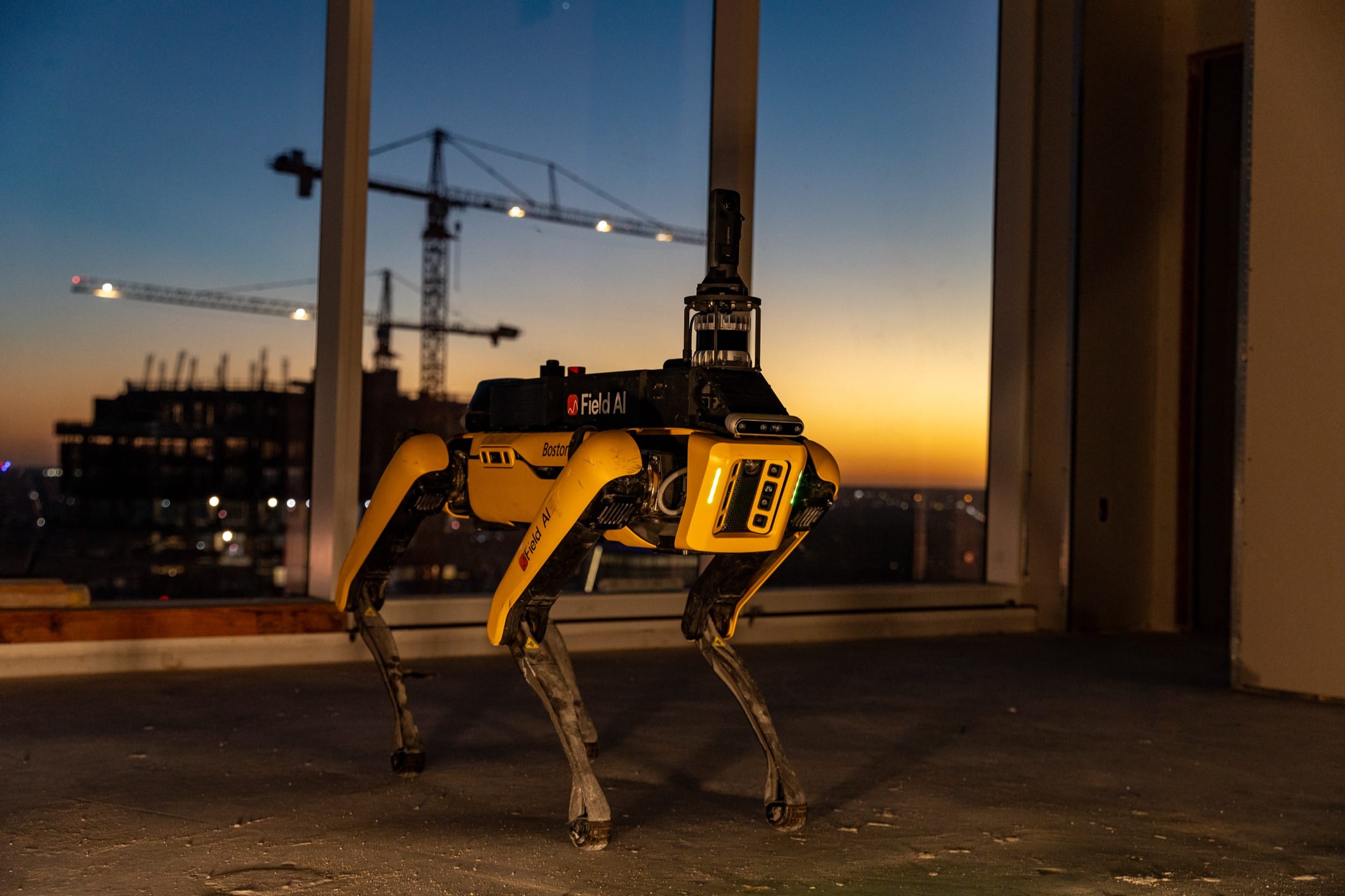
Building on its success in construction, FieldAI is expanding into energy, security, manufacturing, logistics, and infrastructure. Across these sectors, the challenge is consistent: rising demand coupled with severe labor shortages. By improving safety and supporting skilled professionals in dirty, dull, and dangerous environments, autonomous systems play a critical role in keeping essential industries running. FieldAI is working toward a future where no one has to perform work that puts humans at unnecessary risk.
“The FieldAI system makes us better at what we do,” said a senior superintendent at a top 10 ENR construction firm. “It gives us greater efficiency, improves documentation, and takes routine tasks off our plate so we can focus on the work that matters most.”
Technology has always been the engine of human progress: raising living standards, reducing suffering, and saving lives. Together, Boston Dynamics and FieldAI are helping write the next chapter in that story.

Robot intelligence built for the real-world.
